


Educational note: This content is for education and does not replace medical care. If you notice a new breast change (lump, skin changes, nipple discharge) or symptoms that worry you, schedule a clinical evaluation.
Definition
Breast cancer explained in plain language
breast cancer is a disease where certain cells in breast tissue begin growing and dividing in an uncontrolled way. Over time, these cells can form a mass (a tumor) and, in some cases, spread beyond the breast to lymph nodes or other organs.
Everyone has some breast tissue, so breast cancer can occur in people of any sex. Many outcomes have improved because screening can find changes earlier and treatments are more tailored than in the past.
Common types you may hear
- Ductal carcinoma in situ (DCIS): abnormal cells confined to the milk ducts (non-invasive).
- Invasive ductal carcinoma (IDC): starts in ducts and spreads into nearby tissue (most common invasive type).
- Invasive lobular carcinoma (ILC): starts in lobules (milk-producing glands).
- Inflammatory breast cancer: uncommon, can appear quickly with redness and swelling.
- Paget disease of the nipple: rare form involving the nipple/areola area.
- Male breast cancer: uncommon, but possible.
What “spread” means
When breast cancer spreads to lymph nodes or other organs, it’s often called metastatic disease. This affects treatment choices, but many people live meaningful, active lives with modern therapies and good symptom support.
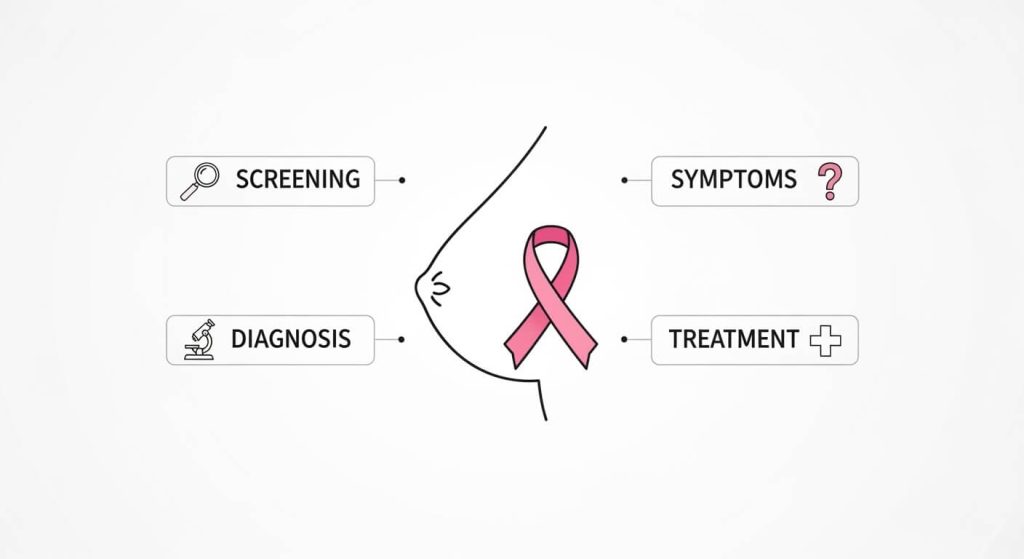
Causes
Why breast cancer happens: DNA changes plus risk factors
Most cases begin when DNA changes occur in breast cells. These changes can disrupt normal growth controls, allowing cells to multiply too fast or avoid “shutdown” signals the body uses to remove damaged cells.
It’s rarely one single cause. Instead, breast cancer usually reflects a combination of biology, age-related changes, hormone exposure, and sometimes inherited risk.
Risk factors you can’t fully control
- Age: risk rises over time.
- Family history: having a close relative with breast cancer can increase risk.
- Inherited gene changes: variants such as BRCA1/BRCA2 can substantially raise lifetime risk in some families.
- Dense breast tissue: can both increase risk and make screening images harder to interpret.
- Prior chest radiation: especially at younger ages.
Risk factors you may be able to influence
- Alcohol intake: higher intake is linked with increased risk.
- Body weight after menopause: obesity is associated with higher risk.
- Physical inactivity: regular movement supports overall health and may reduce risk.
- Hormone exposure: some postmenopausal hormone therapies can increase risk depending on formulation and duration.
A note about “no risk factors”
Many people diagnosed with breast cancer don’t have an obvious risk factor or family history. That’s why screening and paying attention to new changes matter.
Symptoms
Signs of breast cancer and changes worth checking
Some people notice symptoms first; others have no symptoms and are diagnosed by screening. Most breast changes are not cancer, but any persistent or new change deserves a medical review.
Common symptoms
- A new lump or thickened area that feels different from surrounding tissue
- Change in size or shape of the breast
- Skin changes (dimpling, puckering, or “orange peel” texture)
- Nipple changes (new inversion, flattening, scaling, or crusting)
- Nipple discharge, especially bloody or clear discharge that is new and spontaneous
- Swelling in part of the breast or underarm
Symptoms that can suggest a fast-moving pattern
Inflammatory breast cancer can show:
- Rapid swelling or heaviness
- Redness or warmth over the skin
- Tenderness or pain with a sudden onset
These symptoms can also come from infection, but because timing matters, prompt evaluation is important.
When to get urgent evaluation
Seek same-day or urgent care if you have:
- Significant redness/swelling with fever
- Rapidly worsening pain and skin changes
- Heavy bleeding from the nipple (rare, but urgent to evaluate)
Diagnosis
How breast cancer is found: screening, imaging, and biopsy
Diagnosis usually happens in steps. The goal is to confirm what a change is, how big it is, whether lymph nodes are involved, and what “type” it is biologically.
Screening vs. diagnostic testing
- Screening looks for early changes before symptoms (most commonly mammography).
- Diagnostic testing evaluates a specific concern (a new lump, abnormal screening result, nipple discharge).
Common tests
- Mammogram: first-line screening tool for many people.
- Breast ultrasound: helpful for distinguishing solid vs fluid-filled findings and evaluating areas of concern.
- Breast MRI: used for certain high-risk situations or when more detail is needed.
- Biopsy: the definitive step; a small tissue sample is examined under a microscope.
Receptor status and why it changes treatment
If breast cancer is confirmed, the pathology report often includes:
- ER/PR (estrogen/progesterone receptors): can indicate benefit from hormone-blocking therapy.
- HER2 status: can guide HER2-targeted treatments.
- Grade: how aggressive the cells look.
- Stage: how far it has spread locally or beyond.
If you want a broader foundation first, see Generic vs. Brand-Name Drugs: Key Differences (helps clarify medication decisions and terminology) and then come back to this page.
Medications
Medicines used in breast cancer care
Medication plans depend on stage, receptor status, overall health, and goals (cure, control, symptom relief). Many people receive a combination over time.
Main medication categories
- Hormone therapy: used when tumors are hormone-receptor positive (ER/PR+).
- Chemotherapy: may be used before surgery (neoadjuvant) or after (adjuvant), and in metastatic disease.
- Targeted therapy: aimed at specific tumor features (for example, HER2-targeted medicines).
- Immunotherapy: used in selected settings based on tumor biology and stage.
Supportive medications matter, too
To reduce side effects and protect quality of life, care teams may use:
- Anti-nausea medicines
- Pain control strategies
- Medications for bone health when indicated
- Infection prevention in higher-risk situations
If you’re comparing access or affordability for specialty meds, this guide can help: Stelara Assistance in Mexico.
Treatments
Treatment options for breast cancer: what the plan can include
Treatment is personalized. Two people with the same diagnosis name may receive different plans based on staging, receptor status, and preferences.
Local treatments
- Surgery: lumpectomy (breast-conserving) or mastectomy; lymph node evaluation may be done.
- Radiation therapy: often used after lumpectomy and sometimes after mastectomy depending on risk features.
Systemic treatments
- Medication therapy (hormone therapy, chemo, targeted therapy, immunotherapy) may be given:
- Before surgery to shrink a tumor and assess response, or
- After surgery to reduce recurrence risk, or
- As main treatment in metastatic disease
Reconstruction, fertility, and survivorship
Depending on your situation, you may discuss:
- Breast reconstruction options (immediate or delayed)
- Fertility preservation before certain treatments
- Long-term follow-up and monitoring after active treatment
Palliative care is not “giving up”
Supportive/palliative care focuses on symptom relief, stress reduction, and quality of life. It can be used alongside active cancer treatment at any stage.
FAQs
Quick answers about breast cancer
Is a breast lump always breast cancer?
No. Many lumps are benign (such as cysts or fibroadenomas). Still, any new lump should be evaluated—especially if it persists, grows, or feels different from surrounding tissue.
What screening is recommended?
Screening depends on age, personal risk factors, and family history. If you have higher risk (strong family history or known genetic risk), you may need earlier or additional testing. Discuss the best plan with a clinician who knows your history.
What does “dense breasts” mean?
Dense breast tissue means there is more glandular/fibrous tissue compared to fat on imaging. It can slightly increase risk and can make findings harder to see on a mammogram, so your clinician may discuss supplemental imaging.
Should everyone get genetic testing?
Not everyone. Genetic counseling/testing is often recommended when there’s a strong family history, early diagnosis in the family, multiple related cancers, or certain pathology patterns. A counselor can explain benefits, limits, and implications for relatives.
Can lifestyle reduce risk?
Lifestyle changes can’t guarantee prevention, but they can lower risk and support overall health: limiting alcohol, staying active, maintaining a healthy weight, and keeping up with recommended screening.
References
Evidence-based sources used for this overview
For a trusted, patient-focused summary and definitions, see the National Cancer Institute page on breast cancer.