

Insulin from Mexico made obvious financial sense for years. Caps and manufacturer programs in the United States changed that for many patients. For others, particularly the uninsured or those on specific analogs, the gap remains. The honest answer depends on which group you are in.
Insulin was for years the emblem of American drug pricing, and the border trip became a story that ran in national media. Since then the picture has shifted, and a lot of published content has not caught up.
This guide is the updated version, including the part that costs us business.
What changed in the United States
Caps on out-of-pocket insulin costs and manufacturer price reductions changed the calculation for a large share of patients. If you are covered by a program that caps your monthly cost, the arithmetic for insulin from Mexico likely no longer favors traveling.
Saying that plainly costs us a customer and earns a reader. We would rather have the reader.
Who the gap still affects
- Uninsured patients who do not qualify for or cannot navigate manufacturer programs.
- Patients on specific analogs not covered by the caps that apply to others.
- Patients needing large volumes, where per-unit differences still compound.
- Patients already crossing for other specialty medication, where insulin is incremental.
How insulin from Mexico is actually sold
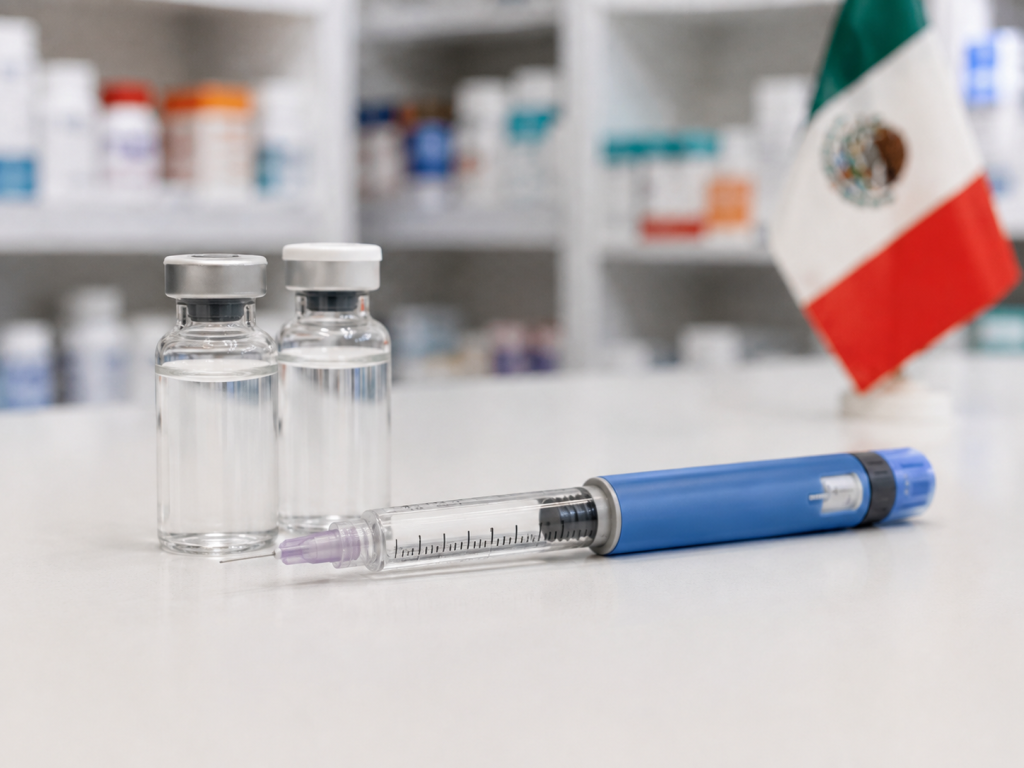
It is available at licensed pharmacies in the analogs and presentations you would expect. It is a prescription medication and it is refrigerated, which makes cold chain the central practical issue, more than price.
Insulin that has been allowed to warm is compromised, and you cannot tell by looking. Ask how it is stored, how it is handled at pickup, and how long it is safe unrefrigerated during your return. A pharmacy that cannot answer these questions precisely is not the right pharmacy for insulin, regardless of price.
Before you decide
- Check what you currently pay after any cap or manufacturer program.
- Get a written quote for the same analog, strength and quantity.
- Add travel time and cost to the comparison, honestly.
- Confirm cold-chain handling for the full journey.
- Read the legal guidance on bringing medication back.
If the numbers come out close, stay home. That is the correct answer often enough that we put it in writing.
Federal law generally does not permit individuals to import prescription drugs for personal use. The FDA operates a Personal Importation Policy, a form of enforcement discretion that describes when the agency typically does not intervene. It is not a legal permission, and the FDA has stated it was not intended as a route to lower-priced medication. Read our full breakdown before you travel.
What to ask before you commit
Four questions separate a well-planned purchase from an expensive mistake, and all four are about handling rather than price.
- How has it been stored? Ask for the specific answer, not a reassurance.
- How is it handled at pickup? The transfer point is where cold chain usually breaks.
- How long is it safe unrefrigerated? That figure determines your return window.
- What documentation comes with it? Batch and expiry should be visible on sealed packaging.
Quick answers
Is insulin from Mexico cheaper?
Often, but the gap narrowed for many U.S. patients after recent caps.
Do I need a prescription?
Yes.
How do I keep it cold on the way back?
Use an insulated container with cold packs, and plan for border wait times.
Is it the same insulin?
Frequently the same manufacturers and analogs. Verify handling.
Should I still consider insulin from Mexico?
Only if you have run the comparison above and the difference is still meaningful for you.
Get your price before you travel
Send us your prescription through our secure portal and a bilingual case manager confirms availability and your exact cost in writing. No charge, no obligation.
Educational content only. Not medical advice. Verify current U.S. program eligibility before making decisions.