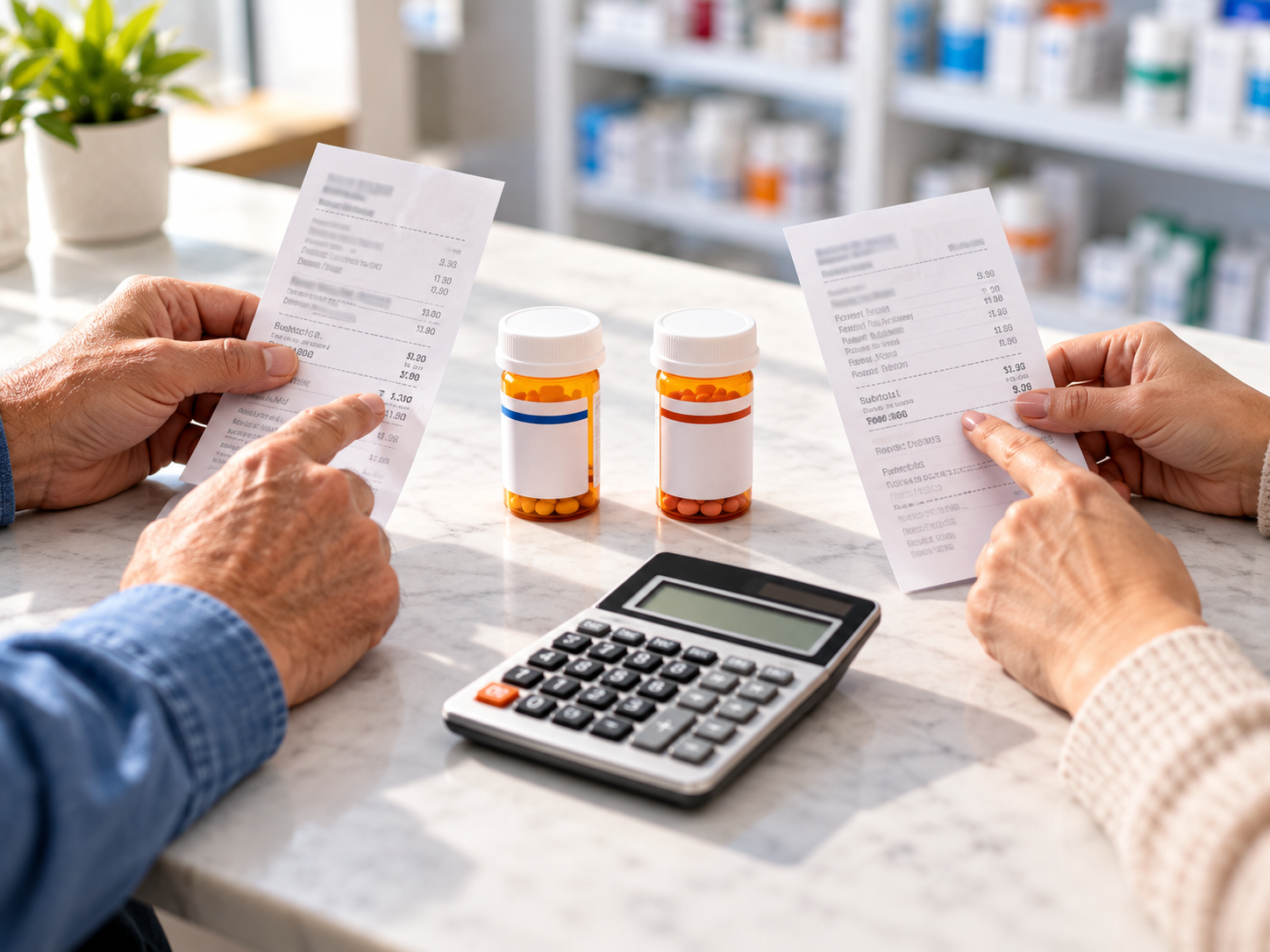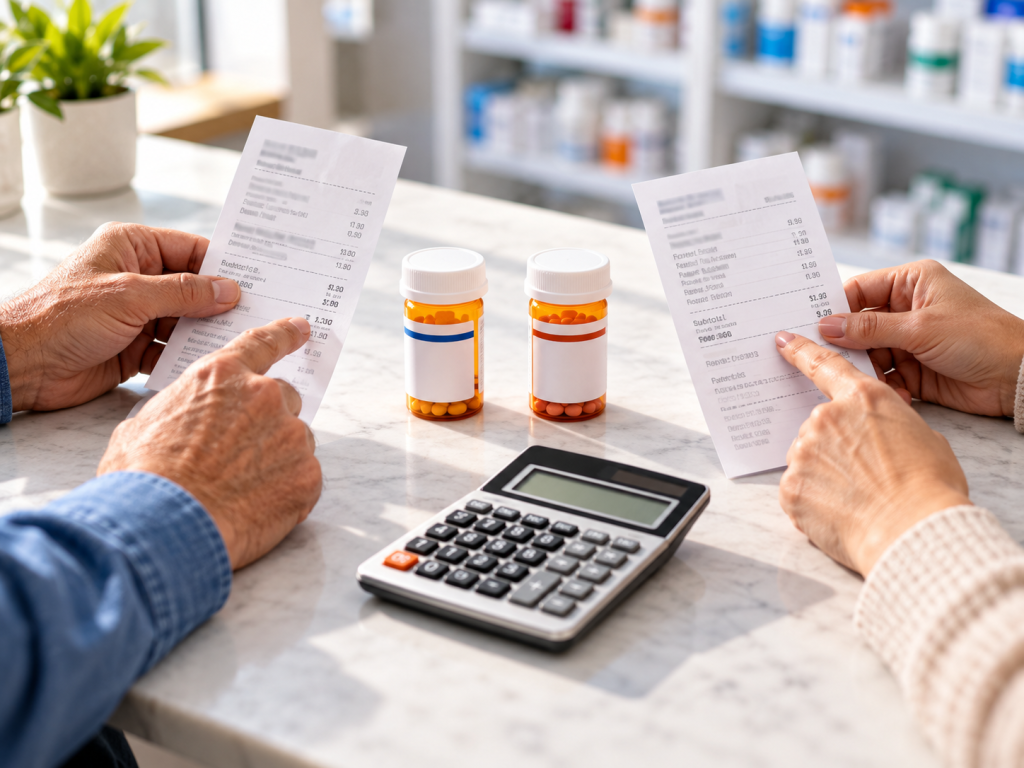



Otezla cost surprises people because the medication is a tablet, not an injection, which leads a lot of patients to assume it will be priced like an ordinary prescription. It usually is not. Understanding why a pill ends up on a specialty tier explains most of what is confusing about the number, and points at the handful of things that actually change it.
Key takeaways
- Otezla is oral, but it is commonly placed on a specialty tier, which means coinsurance rather than a flat copay.
- Coinsurance is a percentage, so your cost moves with the drug’s price, unlike a copay.
- Step therapy is common: many plans require a documented trial of other treatments first.
- Being an oral tablet makes it one of the few specialty-class medications where cross-border logistics are genuinely straightforward.
- Direct-to-consumer purchase channels now appear in search results for this drug. Verify legitimacy before using any of them.
What Otezla is
Otezla is the brand name for apremilast, an oral small-molecule medication that works by inhibiting phosphodiesterase 4 (PDE4), an enzyme involved in inflammatory signaling. It is prescribed for conditions including plaque psoriasis, psoriatic arthritis and oral ulcers associated with Behçet’s disease. The NIH’s overview of psoriasis and the National Psoriasis Foundation publish patient background on the conditions, and full prescribing information is available on DailyMed.
Clinically, one of its practical distinctions is that it does not require the routine laboratory monitoring that some systemic treatments do. That is a convenience factor your dermatologist or rheumatologist may weigh. It is not, however, what determines your bill.
Why a pill ends up on the specialty tier
Most people assume “specialty” means injectable, refrigerated or infused. For insurers it means something much simpler: expensive, used for a complex condition, and usually requiring prior authorization. Apremilast meets that definition despite being a tablet you swallow at home.
The consequence is the part that catches people out:
| Standard brand tier | Specialty tier | |
|---|---|---|
| How you are charged | Usually a flat copay | Usually coinsurance, a percentage |
| Does your cost move with the drug’s price? | No | Yes, directly |
| Where you can fill it | Most retail pharmacies | Often a designated specialty pharmacy only |
| Prior authorization | Sometimes | Almost always |
| Step therapy | Rare | Common |
If your plan charges coinsurance, you are exposed to the drug’s price rather than insulated from it. That single fact explains most of the variance between what two insured patients report paying.
Step therapy: the delay nobody budgets for
Many plans will not approve Otezla until you have documented an inadequate response to one or more other treatments first. This is step therapy, sometimes called “fail first.” It is a cost-control mechanism, and it is usually appealable.
Three things make an appeal more likely to succeed:
- Documentation of prior trials. If you have already tried and failed the required treatments, even years ago or under a different insurer, get that into the record.
- A documented contraindication. If the required first-line treatment is medically inappropriate for you, your prescriber can say so explicitly in the request.
- Speed. Appeals have deadlines. Expedited review exists where delay would harm you.
If you have already been denied, our guide to what a prior authorization denial means and your options walks through the process in detail.
The generic apremilast question
Because apremilast is a small molecule rather than a biologic, a true generic is possible, which is structurally different from the biosimilar situation facing injectable treatments for the same conditions. Whether a generic is dispensable to you on a given day depends on approval status, patent position and your plan’s formulary.
That is a moving target, and the only trustworthy answer comes from your pharmacist today. Ask directly: “Is generic apremilast available, is it on my formulary, and what tier is it on?”
Paying for it: what actually lowers your Otezla cost
Commercial insurance
Manufacturer copay assistance is generally available and is often the dominant factor. Check whether your plan applies that assistance to your deductible. If it runs an accumulator or maximizer program, it may not. See copay accumulator vs copay maximizer.
Medicare
Copay cards are not available to you. The realistic routes are independent charitable foundations and the manufacturer’s patient assistance program, within the structure of the Part D out-of-pocket cap. We cover the 2026 numbers in Medicare Part D’s $2,100 cap in 2026.
Cash and direct-to-consumer
Direct purchase channels, including manufacturer-run and government-run sites, have begun appearing in search results for widely used brands. Some are legitimate. Before entering payment details anywhere, confirm the site is the one it claims to be, ideally by navigating from the manufacturer’s own domain or a verified government domain rather than from a search result or an advertisement.
Why an oral treatment changes the cross-border calculation
This is where Otezla differs meaningfully from the injectable biologics used for the same conditions. A tablet has no cold chain. It does not need an insulated container, a temperature logger, or a plan for what happens if the drive home takes three hours longer than expected. Logistically it is simply far easier.
That does not make availability automatic. Whether a specific presentation and strength is stocked at a given pharmacy on a given day is a question that has to be answered before travel, not at the counter. And the rules on bringing medication back into the United States apply regardless of formulation. See the FDA’s Personal Importation Policy, explained.
Provide Rx Services does not prescribe, sell or dispense medication. A case manager’s role here is narrow and concrete: confirm in advance whether the product is obtainable, so nobody travels on a guess.
Final thoughts
Confusion about Otezla cost comes from a mismatch of expectations: it looks like an ordinary prescription and is priced like a specialty one. Once you know your tier, whether you are on copay or coinsurance, and whether step therapy applies, the number stops being mysterious, and the levers that actually move it become obvious.
Frequently asked questions
Why is Otezla on a specialty tier if it is just a pill?
Insurers classify by cost and complexity, not by formulation. A medication can be an oral tablet and still be designated specialty because it is expensive, treats a complex condition and requires prior authorization. The practical effect is coinsurance instead of a flat copay.
What is the difference between a copay and coinsurance here?
A copay is a fixed dollar amount that does not change if the drug’s price changes. Coinsurance is a percentage of the drug’s cost, so your payment rises and falls with the price. Specialty tiers typically use coinsurance, which is why two insured patients can report very different amounts.
My plan requires me to try another treatment first. Can I challenge that?
Usually yes. Step therapy requirements are appealable, particularly where you have already tried the required treatment under a previous insurer or where it is medically inappropriate for you. Your prescriber initiates the appeal, and expedited review exists where a delay would cause harm.
Is there a generic version of Otezla?
Apremilast is a small molecule, so a conventional generic is possible, unlike the biologics used for similar conditions, which can only have biosimilars. Availability on your formulary on a given day is a question for your pharmacist, since approval and patent positions change.
Is the Otezla cost lower across the border?
Logistically an oral tablet is far easier to obtain abroad than a refrigerated biologic, because there is no cold chain to maintain. But availability still has to be confirmed for the specific product in advance, pricing varies by pharmacy and day, and US rules on bringing medication back apply to all formulations.
Confirm availability before you travel
Send us your prescription and a bilingual case manager will verify whether your medication is obtainable and what it would cost, usually within 24 hours.
Get my free quoteTalk to a case managerProvide Rx Services is a U.S.-based concierge service specializing in Prescription Tourism. We do not prescribe, sell, or dispense medications. This article is general information, not medical advice.